


Collection Systems & Stormwater Conference 2026 and Water-AI Nexus Workshop Connect Innovation, Infrastructure, and Community Trust
The Water Environment Federation's Collection Systems & Stormwater Conference brought water professionals to Portland, Oregon, for four days of technical education, collaboration, and practical solutions focused on protecting public health and the environment. The week began with a co-located Water-AI Nexus workshop, co-hosted by WEF and Autodesk, which explored how the water sector can help guide the responsible development and application of artificial intelligence and other emerging technologies.
Facilitated by Erin (Pink) Mosley and featuring insights from Matt Rea, the workshop brought together leaders from across the water and technology sectors to examine opportunities and challenges at the intersection of water and AI. As a newly joined Water-AI Nexus Advisory Council member, Autodesk is contributing its expertise and resources to advance the initiative's mission of accelerating sustainable water management while enabling responsible technological innovation.
One clear takeaway emerged from the discussion: this is a pivotal moment for the water sector. Water professionals are uniquely positioned to help shape how emerging technologies are deployed, ensuring innovation strengthens water stewardship and supports resilient communities. Reflecting on the value of the workshop, attendee Chad Lawrence of Autodesk emphasized the importance of collaboration and shared learning:
"It's always super energizing to me, it kind of fills my emotional tank, when I'm in a room with a bunch of people who are trying to solve these issues and learn and share best practices. It's a reminder that I'm not alone, that I'm not the only one thinking about these challenges and how the industry moves forward. We move forward together through events like this. We continue to learn. We continue to share those best practices."
The conference opened the following day by challenging attendees to think beyond infrastructure alone. Quisha Light, Interim Director of Portland's Housing Bureau, framed collection systems as "public trust systems," reminding attendees that while these systems may be invisible when functioning properly, failures are experienced personally by the communities they serve. Light emphasized that trust exists at multiple levels, from confidence that systems are planned, maintained, funded, and transparent about risk, to trust built through direct interactions between utilities and the public. Her message underscored the importance of meeting communities where they are, listening to their needs, and recognizing that effective public service requires both technical excellence and human connection. As she noted, "Trust is also a collection system. Build it. Inspect it. Maintain it. Repair it when it breaks."
That theme of connection continued with Opening General Session speaker Wendell Baskins, President of the Oregon-California Trails Association, who explored the central role waterways played in westward migration along the Oregon Trail. Together, the workshop and opening speakers provided context for the week's technical discussions, highlighting how innovation, infrastructure, and human relationships are all essential to the future of water management.
Bringing together operators, engineers, utility leaders, regulators, consultants, and technology providers, the conference featured pre-conference workshops, facility tours, technical sessions, and peer exchanges focused on system resilience, stormwater management, wet weather challenges, asset management, utility operations, emerging technologies, and climate-driven risks. Together, these learning opportunities provided attendees with practical strategies and innovative approaches they can apply in their own communities.
About WEF
The Water Environment Federation (WEF) is a not-for-profit, nonpartisan organization providing water professionals with the latest in education and training. WEF is leading the transformation to the Circular Water Economy: reducing waste, recovering resources, and regenerating ecosystems. Founded in 1928, WEF's mission is to inspire its 31,000 members and 75 affiliated member organizations and the water community in pursuit of human and environmental wellbeing. WEFTEC, WEF’s premiere event, is the largest annual water quality exhibition in North America attracting a diverse, global audience. More than 20,000 registrants and 1,000 exhibitors convene at WEFTEC to experience innovative solutions and gain expert insights that positively impact the future of water. For more information, visit wef.org.


Related Areas

Latest News

More WEF Blogs
Cybersecurity and Water Resilience: What Recent Utility Incidents Can Teach Us
The recent cybersecurity attacks affecting water and wastewater utilities across multiple states serve as an important reminder of a reality facing the water sector ...
Continue Reading
From Madrid to Singapore: The Water-AI Nexus Goes Global
This summer, the conversation at the confluence of water and artificial intelligence traveled well beyond our own events. It showed up on two continents and among ...
Continue Reading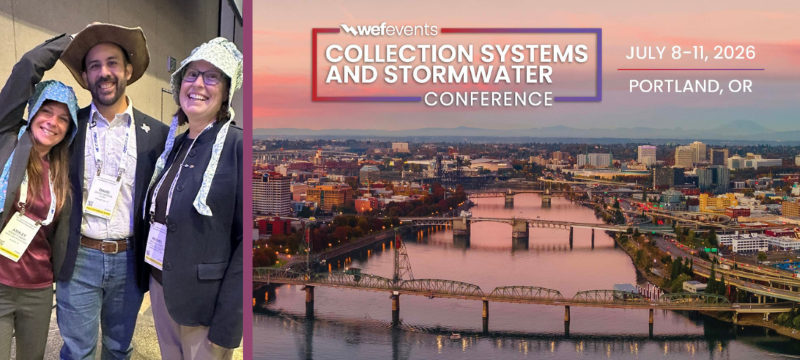
Collection Systems & Stormwater Conference 2026 and Water-AI Nexus Workshop Connect Innovation, Infrastructure, and Community Trust
The Water Environment Federation's Collection Systems & Stormwater Conference brought water professionals to Portland, Oregon, for four days of technical education, ...
Continue ReadingWhere the Water Community Connects
See how WEF connects the people and ideas driving clean water and public health. Membership gives you access to benefits, resources, and a network committed to impact.
EXPLORE ALL PRACTICE AREAS
WEF is a source of high-quality technical resources featuring the latest research, news, and education. WEF's members and other credible resources have created and compiled this information into the Practice Area groupings listed in the dropdown menu.